
VPN and Utility Offers: How to Match the Right Traffic Format Before You Spend a Dollar

Push traffic is the default format for VPN and utility offers because it reaches opted-in audiences with security-oriented messaging at low CPCs. Pop works as a volume tool in Tier 2/3 GEOs where cost per install matters more than intent. Native converts in DACH and Nordic markets where editorial context drives higher-quality clicks. The format that wins isn’t the cheapest — it’s the one that matches your offer’s conversion window and your GEO’s content consumption habits.
Why the Format Question Comes Before the Offer Question
Most affiliates pick the offer first. They find a VPN with a $14 CPA, check that it accepts push and pop, and start testing. The format is an afterthought — whatever the network has most volume on. This is backwards.
The format you choose determines who sees your ad and in what context. That context sets the ceiling on your conversion rate before a single impression is served. A security-focused VPN offer shown in an editorial native placement and the same offer shown as an unexpected popunder are reaching functionally different audiences — even in the same GEO.
Format selection is audience context selection. Get it wrong and no amount of creative testing or bid optimization will fix the underlying mismatch.
The decision tree looks like this:
- What does the offer ask the user to do? (Install, trial, subscribe)
- How much friction does that action carry?
- Which format matches that friction level?
- Which GEOs support that format at scale?
Only after you’ve answered these four questions does bid strategy, creative angle, or landing page structure become relevant.
Why Push Became the Default Format for VPN and Security Offers
Push isn’t dominant in this vertical by accident. The mechanics matter. A user who receives a push notification has previously opted in to receive messages from a publisher’s site. That opt-in is a small but real signal of receptivity. They didn’t block notifications. They didn’t ignore the permission prompt. In the context of cold traffic formats, this is meaningful.
For VPN and security messaging, that baseline receptivity combines well with the creative format. Push ads look like system notifications. A message about a security threat, an expired protection, or a privacy risk fits naturally inside the notification UI — more naturally than it would in a banner or a popunder. The format amplifies the creative angle rather than working against it.
Male users account for around 62% of the VPN audience, skewing toward the 25–44 age bracket (Security.org, 2025 VPN Consumer Report). Push audiences on major networks follow a similar demographic distribution. The format reaches the right people without requiring demographic targeting layers that add complexity and cost.
On the economics: push CPCs in VPN verticals typically run $0.005–$0.05 depending on GEO and network. Tier 1 markets (US, UK, DE) sit at the higher end. Tier 2 (IN, BR, ID, MX) at the lower. At $0.01 CPC with a 1.2% CTR, you’re generating clicks at $0.83 each — competitive for a vertical where CPA payouts range from $8 to $25.
Where push breaks down
Frequency is the variable most affiliates under-manage. Push fatigue is real. A user who sees your VPN notification three times in two days without converting has effectively told you something. Running the same creative at uncapped frequency doesn’t give you more data — it gives you worse data and burns the subscriber list.
The practical rule: cap frequency at 2–3 impressions per user per day. Rotate creatives every 4–5 days. If your CTR drops more than 30% week-over-week without a bid change, frequency is the first thing to check.
The second failure mode is GEO-format mismatch. Push performs well across most Tier 1 and Tier 2 markets. But in GEOs with low push subscription penetration — some Southeast Asian markets, parts of MENA — inventory is thin and quality is inconsistent. Volume looks attractive at the network level; actual conversions are concentrated in a fraction of the publishers.
The fix: use publisher-level reporting from day one. Don’t let a network’s aggregate numbers obscure what’s happening at the source level.
When Pop Traffic Makes Sense for Utility Offers — and When It Doesn’t
Pop is a volume format. That’s not a criticism — it’s a description. A popunder appears without any prior opt-in. The user didn’t ask for it. They’re mid-session on something else when your landing page loads behind their active window. The context is interruptive by design. Intent, in the traditional sense, doesn’t exist here.
Pop works in a specific set of conditions:
- The offer has a short conversion window (install, trial activation, one-click flow)
- The landing page does heavy lifting on the value proposition
- The GEO has low CPC costs that make lower CR economically viable
- The offer accepts pop traffic in its terms (not all do)
For utility offers — antivirus, PC cleaners, VPN trials — pop can work well in Tier 2 and Tier 3 markets precisely because the economics tolerate lower intent. At $0.50–$2.00 CPM, you can drive enough volume to find converting publisher segments even at a 0.3–0.5% conversion rate.
India, Brazil, Indonesia, Mexico, and the Philippines consistently appear as top-performing GEOs for utility offers on pop. These markets combine high mobile penetration, price-sensitive audiences who respond to free trial flows, and pop inventory that’s both abundant and cheap.
The model that breaks
Pop fails for subscription-focused VPN offers where the advertiser is optimizing for LTV rather than install volume. If the offer pays $14 on a trial but requires a 30-day retention to unlock the payout, pop traffic’s low-intent audience creates a conversion quality problem. The install happens. The retention doesn’t.
Advertisers running subscription models with long retention windows will either reject pop traffic outright or enforce quality checks that result in high reversal rates. If you’re seeing consistent payout delays or reversals on pop campaigns, this is the most likely cause — not your landing page.
The diagnostic question before launching pop for any VPN or utility offer: what is the advertiser’s conversion event? Install = pop-compatible. Subscription with retention clause = proceed with caution or test with a separate, low-budget cell.
Where Native Traffic Actually Converts for VPN — and Why Most Affiliates Miss It
Native is the most misunderstood format in this vertical. The common assumption: native is for finance, nutra, and editorial-heavy verticals. VPN is a direct-response product. These don’t match. The common assumption is wrong — but only in specific GEOs.
In DACH markets (Germany, Austria, Switzerland) and Nordic countries (Sweden, Norway, Denmark, Finland), users consume content differently than in Tier 2 markets. They read before they click. They compare before they install. An editorial-style native placement — “5 Reasons Your Internet Connection Is Being Monitored” or “The Fastest VPN for Streaming in 2026” — matches how these users make decisions.
The conversion timeline is longer. A pop campaign might convert within the session. A native campaign often converts after two to three touchpoints. This means you need either a retargeting capability or enough volume to absorb the delay in your attribution window.
The economics shift accordingly. Native CPMs in DACH run $8–$15 — significantly higher than push or pop. But conversion rates for intent-matched audiences in these markets can reach 2–4% on a strong landing page, and the quality of the converted user is higher. Subscription retention rates in Tier 1 European markets outperform Tier 2 by a meaningful margin.
Why most affiliates avoid it
Two reasons. First, native requires a different creative approach. You’re not writing a notification headline — you’re writing editorial copy that earns a click without screaming “ad.” Most affiliates running push and pop don’t have this in their toolkit and don’t want to build it.
Second, the testing cycle is slower. With push or pop, you can get statistically meaningful data in 48–72 hours at moderate budgets. Native in DACH might require 7–10 days and $500–$1,000 before you have a clear signal. The patience and budget tolerance required is higher.
For affiliates already operating at scale in Tier 1 European markets, native is worth building. For affiliates testing a new GEO, start with push — it gives you faster feedback with less capital at risk.
Which Format Fits Which VPN or Utility Offer?
This is the decision framework. Use it before you build a campaign, not after you’ve already committed budget.
| Offer Type | Conversion Event | Recommended Format | Primary GEOs | Avoid |
|---|---|---|---|---|
| VPN Trial (free install) | App install / trial activation | Push, Pop | IN, BR, ID, MX, PH | Native in Tier 2 |
| VPN Subscription | Paid subscription | Push, Native | US, UK, DE, SE, NO | Pop (retention risk) |
| Antivirus / Utility Trial | Install + scan run | Push, Pop | IN, ID, BR, MX, TR | Native in Tier 2/3 |
| Antivirus Subscription | Paid subscription | Push, Native | US, UK, DE, AT, CH | Pop |
| Freemium Upgrade | In-app purchase | Push | US, UK, CA, AU | Pop, Native |
A few notes on how to read this:
Push appears in almost every row. That’s not an oversimplification — it genuinely is the most format-versatile option across offer types and GEOs. The question isn’t whether push works; it’s how to optimize frequency, creative rotation, and publisher selection within push.
Pop is a Tier 2/3 tool for trial and install flows. If your offer has any retention clause or quality gate from the advertiser, test pop with a small budget cell before scaling.
Native has a narrow but real use case. DACH and Nordics, subscription offers, longer attribution windows. If your offer doesn’t pay on subscription or you’re not targeting those GEOs, native isn’t your format.
The matrix is a starting point, not a guarantee. Offers within the same category vary significantly. An antivirus trial on Kaspersky converts differently than one on a no-name utility — even in the same GEO, same format. The matrix narrows the field; your test data makes the final call.
How to Test Format Fit Without Burning Your Budget
The goal of a format test is a signal, not a scale decision. A format test answers one question: does this format, in this GEO, for this offer type, produce conversions at an acceptable CPA? That’s it. You’re not optimizing — you’re qualifying.
Push format test structure
- Budget: $50–$150 per GEO
- Duration: 48–72 hours
- Creative: 3 variants minimum (headline + icon combinations)
- Frequency cap: 2 per user per day
- Stop criteria: if CPA exceeds 3× target after 50 clicks, pause and diagnose
If you hit 20+ conversions within the test budget, you have a signal worth scaling. Below 10 conversions at budget exhaustion, the signal is too weak — adjust creative or GEO before scaling.
Pop format test structure
- Budget: $30–$80 per GEO (lower CPM means more volume per dollar)
- Duration: 48 hours
- Landing page: single variant, optimized for mobile
- Stop criteria: if conversion rate drops below 0.2% after 5,000 impressions, pause
Pop testing is faster and cheaper, but noisier. Publisher quality variance is high. Always pull source-level data and blacklist non-converting publishers before scaling.
Native format test structure
- Budget: $200–$500 per GEO (higher CPM, slower conversion cycle)
- Duration: 7–10 days
- Creative: 3–5 editorial headline variants
- Attribution window: set to at least 3 days
- Stop criteria: if CTR falls below 0.05% across all creatives by day 4, creative is the problem — not the format
Native tests require more patience and more budget. Don’t evaluate results at 48 hours. The conversion cycle is longer by design.
Running parallel format tests
If budget allows, test push and pop simultaneously in the same GEO with the same offer. The comparative data is more valuable than testing sequentially. You’ll see which format’s economics fit your offer faster, and you avoid the problem of seasonal variation distorting a sequential test.
One operational friction point in parallel testing: every time you switch networks to access a different offer, you’re resetting postback configuration and negotiating traffic source terms from scratch. A cleaner approach is to run both format tests through one network that covers multiple offer types and GEOs natively.
CIPIAI is a CPA network focused on VPN, utility, and mobile app verticals. Their offerwall gives you a consolidated view of available offers — payout structures, accepted traffic formats, and GEO coverage — before you commit budget to any test.
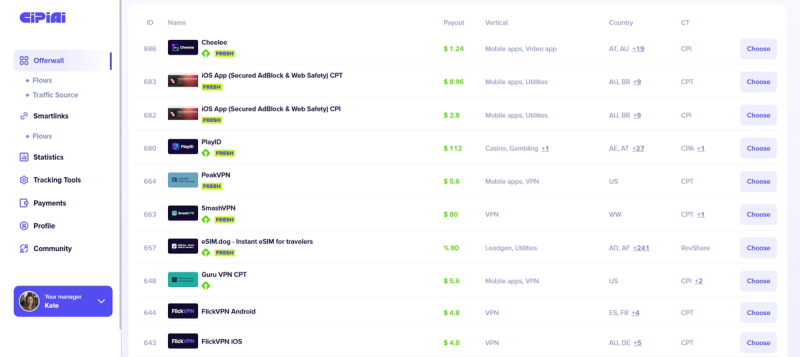
Keeping the offer and postback setup stable across format tests cuts the operational overhead that usually slows down this phase.
If you’re just getting started, sign up and use promo code YOUTARGET for +15% on your first payout.
FAQ
Is push traffic better than pop traffic for VPN offers? For most VPN offers, push outperforms pop on conversion quality. Push audiences have opted in to receive notifications, which creates a baseline of receptivity that pop lacks. Pop can match or exceed push on volume and cost efficiency in Tier 2/3 GEOs for trial and install flows, but underperforms on subscription offers where advertiser retention requirements create reversal risk.
Does native advertising work for VPN and antivirus campaigns? Yes, but in a narrow set of conditions. Native converts for VPN and security offers primarily in DACH (DE, AT, CH) and Nordic markets (SE, NO, DK, FI), where users consume editorial content before making install decisions. CPMs are higher and conversion cycles are longer than push or pop. Outside of Tier 1 European markets, native is rarely the right format for this vertical.
Which GEOs convert best for utility offers on push traffic? For trial and install-based utility offers, top-performing push GEOs are India, Brazil, Indonesia, Mexico, and the Philippines — driven by large mobile audiences and low CPCs. For subscription-based utility offers with higher payouts, the US, UK, Germany, and Australia produce better quality conversions despite higher traffic costs.
How much budget do I need to test a new traffic format for VPN? Push tests require $50–$150 per GEO for a valid signal. Pop tests run cheaper at $30–$80. Native requires $200–$500 and at least 7 days due to longer conversion cycles. These are minimums for a qualifying signal — not budgets for optimization.
Can I run the same VPN offer on multiple traffic formats simultaneously? Yes, and it’s often the faster way to identify the right format. Running push and pop in parallel in the same GEO gives you comparative data within 48–72 hours. Confirm that the offer’s traffic source terms allow both formats before launching — some VPN advertisers restrict pop or require pre-approval for native placements.