RTB vs Direct Deals: Which Yields Better ROI in 2025?
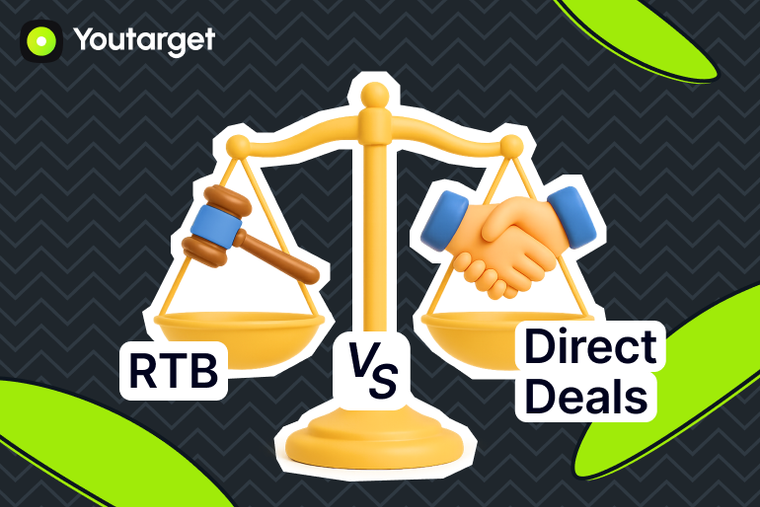
The eternal debate: RTB (Real-Time Bidding) or Direct Deals — which one gives you the best bang for your buck in 2025?
Spoiler: there’s no one-size-fits-all answer. But there are clear advantages (and risks) for both — depending on your goals, GEOs, formats, and how deep you are in the game.
Let’s break it down.
💡 First, What’s the Difference?
RTB (Real-Time Bidding)
Programmatic ad buying through automated auctions in real-time. You set bid limits, targeting, and let the system compete for impressions.
✔ Scalable
✔ Fast optimization
✔ Granular targeting
✔ Dynamic pricing (bidding per impression or click)
Direct Deals (Direct Buys)
Manual traffic buying — you negotiate directly with the publisher or platform, set fixed pricing (usually CPM or CPC). And reserve inventory.
✔ Guaranteed placements
✔ Fixed rates (no auction swings)
✔ Predictable spend
✔ Often comes with premium ad slots
🎯 Which Performs Better in 2025?
Here’s the real talk:
✅ Why RTB Still Wins for Many Affiliates:
— Massive reach — thousands of sites, apps, placements
— Easy GEO/device segmentation
— You can start small and scale as you optimize
— Supports micro-bidding, auto-optimization, and AI bidding
— Fast testing for new offers, verticals, or GEOs
— Ideal for Push, Popunder, Native formats
🔥 Best for: Arbitrage, CPA offers, testing new GEOs, low-margin campaigns where you need fast ROI.
✅ Where Direct Deals Shine:
— Top-tier inventory with premium publishers
— Long-term branding or high-visibility campaigns
— Higher CTRs on certain placements (if audience fit is strong)
— Predictable spend and guaranteed volume
— Often bundled with added bonuses: newsletters, native placements, etc.
🔥 Best for: Brand campaigns, mainstream verticals (finance, iGaming), or when you already know the exact traffic source converts.
⚠️ Hidden Risks of Each:
RTB Risks:
— Bidding wars can push costs higher
— Requires smart optimization (bad setup = money burn)
— Needs robust tracking to avoid junk traffic
— Some platforms resell low-quality or recycled traffic (watch for this!)
Direct Deal Risks:
— Higher upfront cost (often requires a bigger test budget)
— No flexibility once locked in
— Less granular targeting
— Risky if you don’t fully trust the publisher
✅ Our Honest Take (Based on Real Campaigns):
In most performance-driven campaigns (affiliate, arbitrage, leadgen), RTB usually brings better short-term ROI — thanks to flexibility, automation, and wide reach.
Direct deals make sense when:
— You’re already scaling profitably
— You want stable delivery
— You’ve already tested RTB and want more predictable volume
💡 Pro Tip: Combine Both
Many advanced buyers do exactly this:
— Test with RTB → Optimize funnel → Lock in direct deals only when proven
— Mix RTB for scale + Direct Deals for stability
Why Youtarget Buyers Prefer RTB:
We specialize in RTB-based traffic — Push, Popunder, Native — with:
✔ Full control over GEOs, devices, time
✔ Micro-bidding by zone, ISP, OS, etc.
✔ Anti-fraud filtering
✔ CPC, CPM & CPA models
✔ Personal managers for optimization
In 2025, most of our buyers use RTB to test, scale, and optimize on the fly — because that’s where the fastest profits are.
Final Thoughts:
Both RTB and Direct Deals have a place in modern media buying — after all, it’s not either/or.
Initially, start with RTB if you want speed, testing power, and scalability.
Then, move to Direct Deals only once you know exactly where your ROI lives.
👉 In conclusion, looking for fast, scalable RTB traffic?
Youtarget’s Push, Popunder, and Native ad formats are fully optimized for high-ROI campaigns.
Youtarget’s Push, Popunder, and Native ad formats are fully optimized for high-ROI campaigns.
This article is also available in Russian.