Traffic Arbitrage: How It Works and What Decides Your Margin
Traffic arbitrage means buying attention cheaply and selling the conversions it produces for more. The principle has not changed; the tolerance for guesswork has. This is the long version: the terms, where traffic comes from and what it costs by GEO, what actually decides the margin, the six ways budgets die, and when scaling is safe rather than expensive.

Traffic arbitrage means buying attention in one place and selling the conversions it produces in another, at a higher price. You pay a traffic source per thousand impressions; an advertiser pays you per lead, install or deposit. The difference is the business, and it is thinner than it used to be.
What changed is not the principle but the tolerance for guesswork. Competition on the cheap formats is harder, moderation is stricter, and the gap between a campaign that reads its own numbers and one that does not has widened. This is the long version: the terms, where traffic comes from and what it costs, what decides the margin, where budgets die, and when scaling is actually safe.
The terms you actually need
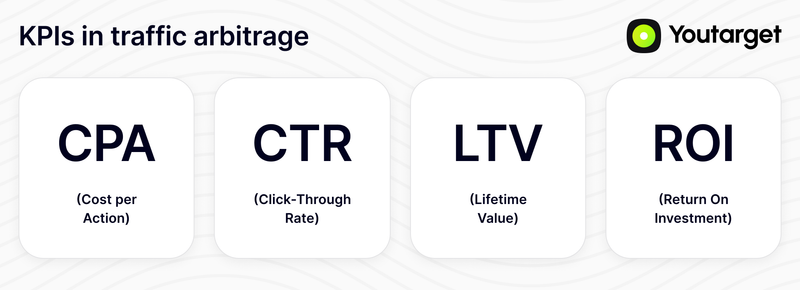
Arbitrage has a vocabulary problem: the same campaign gets described in four different units, and mixing them is how people convince themselves a losing campaign works.
| Term | What it means | Why it decides anything |
|---|---|---|
| CPM | Cost per thousand impressions | What you pay the traffic source. The number you control by bidding |
| CPC | Cost per click | CPM divided by click-through rate — the real cost of a visitor |
| CPA | Cost per acquisition | What you pay for one converted lead. Compare it with the offer payout, not with CPM |
| EPC | Earnings per click | What the offer returns per visitor you send. Your ceiling |
| ROI | Return on investment | (revenue − spend) ÷ spend. Positive on paper is not positive after refunds and shaved leads |
| LTV | Lifetime value | Matters the moment you take a RevShare deal instead of a fixed payout |
The one relationship to internalise: you buy on CPM and get paid on CPA, so click-through rate and conversion rate are the two multipliers that turn one into the other. A campaign fails when either collapses, and the reports rarely tell you which without being asked.
Where the traffic comes from
Every source has a different price, a different level of intent, and a different set of rules about what you may promote. Choosing badly here cannot be fixed downstream by a better landing page.
Pop, push and native from ad networks
The cheapest volume, and where most people start. Intent is low — nobody went looking for your offer — so the creative and the landing page carry the whole persuasion job. Details of how the formats differ and what they cost are in the guide to pop traffic.
PPC and search traffic
Paying per click on a search platform buys intent instead of volume: the person typed the query. That makes conversion rates higher and the maths tighter, because the click already cost more than a thousand pop impressions. Three things decide whether it works: keyword selection narrow enough that the query implies the offer, ad copy that matches the landing page well enough to survive quality scoring, and policies — search platforms restrict exactly the verticals that pay best in arbitrage.
Rising CPC is the structural problem here. On a search platform you are bidding against advertisers monetising the same visitor directly, and they can pay more than you can. PPC arbitrage works in the gaps: long-tail queries the big spenders ignore, and GEOs where their campaigns are not running.
Social platforms
Warmer audiences, cost driven by the creative rather than the bid, and the strictest moderation of the three. The audience is more likely to engage and less likely to tolerate a bait-and-switch, so the creative has to be honest enough to pass review and interesting enough to earn the click without a keyword to lean on.
What each source is actually good for
Simple offers with a short path to conversion suit pop and push. Offers needing explanation suit native and social, where the format allows a sentence of context. Anything with high payout and a comparison step — finance, insurance, software — is where PPC intent earns its premium.
What traffic costs
Prices vary about tenfold by GEO, and the spread is the single biggest input into which offers can work for you. Figures below are from the Youtarget traffic showcase on 30 July 2026, for pop inventory, and move with demand.
| GEO | Available pop impressions | Recommended CPM |
|---|---|---|
| India | 593 M | $0.17 |
| Brazil | 54 M | $0.40 |
| Egypt | 109 M | $0.49 |
| Indonesia | 302 M | $0.73 |
| Germany | 43 M | $1.30 |
| United States | 135 M | $1.63 |
| United Kingdom | 38 M | $1.68 |
Read the pattern rather than the numbers. India at $0.17 and the United States at $1.63 are not the same business: Tier-3 volume is nearly free and converts on low-ticket, low-friction offers, while Tier-1 costs roughly ten times more and only pays back when the offer value absorbs it. Choosing a GEO is therefore choosing an offer type, whether you meant to or not.
Picking the niche and the offer
The instinct is to look for the highest payout. The useful question is narrower: which offers can a stranger with no context complete in one screen, in a GEO whose traffic I can afford?
- Payout against traffic cost, not payout alone. A $30 payout in a GEO where clicks cost $0.30 needs a 1% conversion rate to break even. A $3 payout at $0.01 per click needs the same. The second is easier to test.
- Length of the conversion path. Email submit, then pin submit, then deposit, then purchase — each extra step multiplies the traffic you need.
- Whether the vertical survives your traffic source. Some offers forbid pop; some networks forbid the vertical. Check before producing creatives, not after.
- Competition you can see. If every spy tool shows the same three creatives running for months, the niche works — and the entry price reflects it.
Choosing where to take offers from is a separate decision from choosing traffic: what a CPA offer is and how the payout chain works, and which CPA networks publish terms you can plan around.
What decides the margin
Arbitrage is a bookkeeping business wearing a marketing costume. Four numbers, read at the right level of detail, decide whether it works.
Cost per conversion against payout
The only number that matters at campaign level, and the only one people quote correctly. Everything else exists to explain it.
Performance per zone, not per campaign
This is the decision that separates profitable buyers from the rest. A campaign averaging a loss almost always contains placements that are profitable and placements that are catastrophic. Read the report at zone level, cut what does not convert once it has had enough impressions to be meaningful, raise bids where it does. At pop volumes the work is too repetitive to do by hand, which is what microbidding and automatic rules are for.
Conversion rate by step
Click to landing page, landing page to form, form to confirmed lead. A single conversion-rate number hides which step is broken, and the fix is different at each one.
Payback period
On fixed CPA the money arrives on the network schedule. On RevShare it arrives for months, which changes how much working capital the same campaign needs. How that plays out by GEO is in the comparison of CPA and RevShare payout models.
Where budgets die
Almost every failed campaign fails in one of these ways, and each leaves a recognisable trace in your own statistics.
- Traffic quality. Cheap inventory is cheap for a reason. Without anti-fraud filters and quality classes, the saving on CPM comes straight out of conversion rate.
- Targeting that is too broad. Five GEOs and both device types in one campaign produce an average that describes none of them.
- Click fraud. Clicks with no session depth and no conversions, concentrated in a handful of zones. Visible the moment you look per zone.
- Ad fatigue. Conversion rate decaying while impressions hold steady. Fixed by a frequency cap and creative rotation, not by raising the bid.
- Landing pages that lose the visitor. Low-intent traffic exposes a slow page immediately. Check load time on a mid-range mobile device before blaming the source.
- Not reading the analytics. The most expensive one, because it makes all the others invisible.
When scaling is safe
Scaling is not raising the budget on something that works. The same creative at three times the spend usually buys worse traffic, because the cheap inventory was finite and the auction takes you further down the quality curve.
- Scale when the profitable segment is identified, not when the campaign is positive. You are scaling zones and GEOs, not campaigns.
- Widen before deepening. A second GEO with the same offer usually beats double spend in the first.
- Diversify the source before you need to. A single network going bad should cost you a segment, not the business.
- Watch margin per source as volume grows. Total ROI holding steady while one source degrades is a trap that resolves badly.
Budget control belongs here too: daily caps per campaign rather than per account, so one runaway placement cannot spend a week of budget overnight.
What changed, and what did not
Three shifts are worth planning around, and none of them is a new format.
- Advertisers pay for quality, not signups. Caps, holds and shaving are the mechanism. Traffic that converts but does not retain now gets repriced rather than accepted.
- Moderation tightened everywhere. The creative that worked two years ago gets rejected now, on the same network.
- Tooling stopped being optional. Tracking, zone-level reporting and automatic rules are the baseline; without them the margin is invisible rather than absent.
What did not change: the arithmetic. Buy attention below what the conversion is worth, measure honestly, cut what loses. Every new format and every new platform is a variation on that.
Where to start
A first campaign that teaches you something looks like this: one GEO, one traffic type, one offer with a short conversion path, a tracker configured before launch, and a budget you are prepared to spend entirely on learning. Run it until the zone report has enough data to act on, then cut and rebid rather than restart.
From there the useful next reads are how to choose an ad network for arbitrage, the tools worth having in the stack, where AI genuinely helps and where it does not, and the legal side of buying and reselling traffic.
Frequently asked questions
What is traffic arbitrage?
Buying attention in one place and selling the conversions it produces in another at a higher price. You pay a traffic source per thousand impressions; an advertiser pays you per lead, install or deposit. The difference, after fraud and unconverted traffic, is the margin.
How much money do you need to start traffic arbitrage?
Enough to buy statistically meaningful volume in one GEO with one offer, plus a tracker. On pop inventory that can be tens of dollars in Tier-3 and considerably more in Tier-1, where recommended CPM runs around ten times higher. The amount that fails is the one too small to produce a readable zone report.
Is traffic arbitrage still profitable?
Yes, with less room for error than before. Margins narrowed, moderation tightened and advertisers now pay for player or lead quality rather than raw volume. What still works is the same arithmetic: buy below what the conversion is worth, read performance per zone, cut what loses.
Which traffic source is best for beginners?
Pop and push, because the entry price is low enough that a mistake costs a test rather than a month. The trade-off is low intent: the offer has to be simple enough for someone with no context to complete in one screen. PPC buys intent instead, at a click price that punishes a weak funnel.
What is a good ROI in traffic arbitrage?
There is no universal figure, because payback periods differ: 20% on a fixed CPA offer paid weekly is a different business from 20% on RevShare paid over months. Judge the number against how long your capital is tied up, and against margin per traffic source rather than the campaign total.